Moving to Spain or already living here? Have you registered on the Padrón?
One of the first things I recommend people do when moving to Spain is register on the local Padrón.
It's something that is easily overlooked when you're busy buying a property, organising removals, opening bank accounts and settling into your new Spanish lifestyle.
But the Padrón is more important than many people realise!
Whether you've bought a villa in the countryside, a townhouse in the village, an apartment on the coast or you're renting, if you are living in Spain, you should understand what the Padrón is, why it matters and how to register.
So here's a useful guide for anyone living in or moving to the Guadalhorce Valley, particularly Alhaurín el Grande and Coín.
The Padrón Municipal, also known as the Empadronamiento, is the official register of people who live in a particular Spanish municipality.
Think of it as registering with your local town hall. For example:
It records your residential address and establishes you as a resident of that municipality for local administrative purposes.
You do NOT have to be Spanish, own a property or have a Spanish passport.
You can register if you're renting or living with family or friends, provided you can meet the town hall's address and authorisation requirements.
There are several reasons why this is important.
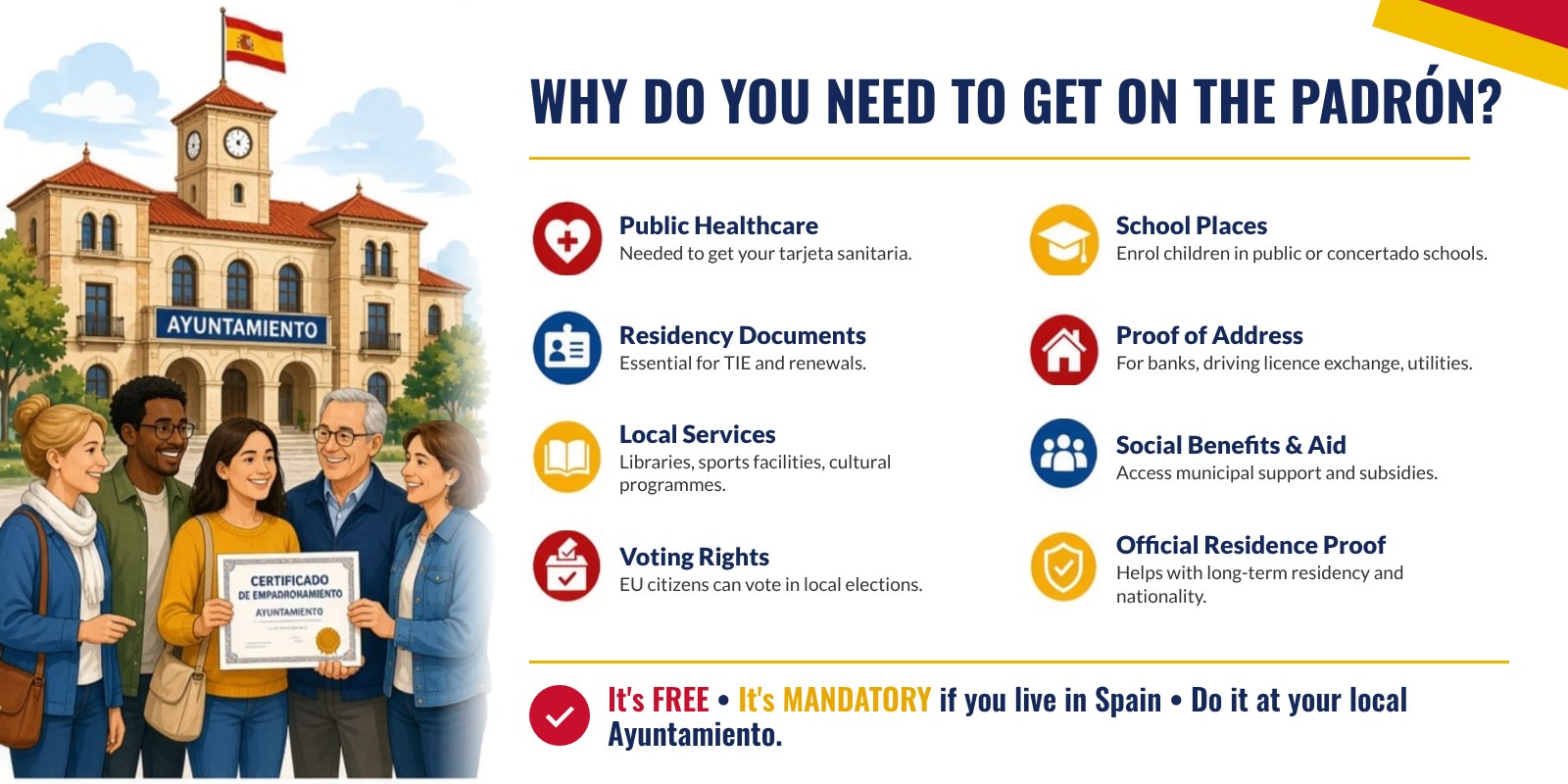
Being registered helps your town hall establish who lives in the municipality and plan local services. It can be relevant to:
If you're moving to Spain with children, your Padrón can be important when applying for local school places and establishing your residential catchment area.
Your Padrón can help establish your address when registering with the local health service and applying for a health centre or GP.
However, please remember that being on the Padrón does not automatically entitle everyone to public healthcare. Your healthcare entitlement depends on your individual circumstances and the relevant Spanish rules.
EU citizens and certain non-EU nationals may be able to vote in municipal elections, subject to nationality, registration and other eligibility requirements.
You will often need an up-to-date Padrón certificate or registration document when dealing with official procedures. It can be useful for:
YES! This is something I particularly want people moving to Spain to understand.
Your Padrón can be useful evidence of where you live, especially when establishing that a property is your habitual or main residence.
However, there are THREE different things that people often confuse:
They are connected, but they are NOT the same thing.
Under the general Spanish rules, you may be considered tax resident if:
There are also rules concerning family circumstances and double taxation agreements.
Simply registering on the Padrón does not automatically make you tax resident, and not registering does not automatically mean you are not tax resident.
This is particularly important for British people who split their time between Spain and the UK.
There are two particularly important Spanish tax exemptions involving your habitual residence.
If you are Spanish tax resident and sell your habitual residence, you may qualify for an exemption from Spanish income tax on the capital gain if you reinvest the qualifying sale proceeds into another habitual residence. Generally:
This is particularly important!
If you are over 65 and sell a property that qualifies as your habitual residence, the capital gain can be exempt from Spanish income tax.
Generally, the property must be your habitual residence when you sell it or have qualified as such at some point during the two years immediately before the sale.
This can make a significant financial difference.
Absolutely. It can be useful supporting evidence of how long you have lived at an address.
But don't assume that simply registering on the Padrón automatically qualifies your property for capital gains tax relief.
The Spanish Tax Agency looks at the actual circumstances and evidence of habitual residence. Other useful evidence can include:
For tax purposes, the habitual residence rules generally include a continuous three-year residence requirement, subject to exceptions, and an effective occupation requirement.
Please speak to a qualified Spanish tax adviser before selling if you think you may qualify for an exemption. It is much better to understand the rules BEFORE putting your property on the market!
The requirements can vary slightly between town halls, but generally you should prepare:
You will also need to complete the Padrón application form, known as the Hoja de Empadronamiento.
Children can also be registered, with the relevant parental identification and documentation.
Here are the details for two of our local municipalities.
The Padrón department is located at:
Casa Consistorial
Plaza del Convento, s/n
29120 Alhaurín el Grande, Málaga
Telephone: 952 49 00 00
Email: padron2@alhaurinelgrande.es
You can arrange Padrón procedures online through the electronic office or in person.
IMPORTANT: For a new registration (Alta) or a change of address, you must request an appointment.
The town hall's official website provides the document checklist and application information.
The town hall is located at:
Plaza Alameda, 28
29100 Coín, Málaga
Telephone: 952 45 30 20
Coín's municipal Padrón is managed through the Ayuntamiento's municipal administration.
I recommend contacting the town hall before visiting to confirm the current Padrón department arrangements, appointment requirements and documentation.
For Spanish nationals and EU citizens, there is no general two-year renewal requirement.
However, certain non-EU foreign nationals who do not have long-term residence status must renew their registration every two years.
If you move house, you should register your new address with the town hall in your new municipality.
You can also request different types of certificates:
These documents can be useful for different administrative procedures.
There are a few important misconceptions worth clearing up:
But it is an important part of getting properly registered and establishing your life in your local Spanish community.
If you've recently moved to Alhaurín el Grande, Coín or one of the surrounding villages, make getting your Padrón sorted one of your first administrative jobs.
Don't wait until you need a certificate urgently for another application.
And if you're planning to live in Spain permanently, make sure you understand your residency, tax and healthcare obligations too.
Spain is a wonderful place to call home, but getting the paperwork right from the beginning can save you a lot of headaches later!
If you're new to the area, welcome!
And if you have any useful local information or experiences to share, please add them in the comments. Let's help one another settle into life in Spain.
Nikki Powles | eXp Realty Spain
Property in Spain Group
Property sales across Málaga, the Costa del Sol and inland Andalusia.
WhatsApp: 0034 654 091 051
Website: https://propertyinspaingroup.com
Email: info@propertyinspaingroup.com
Information is intended as a general guide, not individual legal, tax or immigration advice. Always check current requirements with your local Ayuntamiento and a qualified Spanish tax adviser.

Finding the ideal home or investment in Spain is not just a transaction but a journey, and I am here to guide you every step of the way.
With a global perspective and a deep understanding of what truly makes a house a home, I help my clients navigate the Spanish property market with confidence. Whether you are searching for your dream home or the perfect investment, I offer a professional and personalised approach to ensure the process is clear, seamless, and tailored to your needs.
If you're ready to take the next step, let's talk!
What Should International Buyers Know Before Buying an Equestrian Property Near Coín?
Coín is one of the Costa del Sol's most popular inland towns for horse owners. Located in the beautiful Guadalhorce Valley, it offers excellent riding, large plots of land, a thriving equestrian community, and easy access to Málaga Airport, Marbella, and the coast.
Building Trust in Real Estate with Nikki Powles
Nikki Powles Property in Spain expert, real estate agent who builds trust with clients through open communication and personalised service. With a focus on understanding individual needs, she guides clients through the emotional journey of buying or selling a home with confidence and care.
Navigating the Property Buying Process in Spain
Buying property in Spain is an exciting journey filled with unique challenges. This guide covers essential steps, market insights, and real-life case studies to help you navigate the process smoothly. With proper guidance, your dream home awaits!